
Understanding how dating-app matches become first and second dates.
This qualitative research coursework project looked at the transition from app matching to in-person dating. Dating apps make matching accessible, but the harder question is what gets people from a conversation to a first date, then from a first date to a second.
We studied that process through diary entries and a group interview, then synthesized patterns around filtering, trust, safety, timing, chemistry, and follow-up behavior.
How does a first date happen using dating apps? What about a second date?
Method
We grounded the study in phenomenology, focusing on participants’ lived experience with dating apps rather than treating app behavior as a simple funnel.
The study combined a seven-day diary study with follow-up interviews and a group interview using a mad-lib activity about an ideal date.
Diary study
2
Participants completed seven days of prompts, followed by a short interview.
Group interview
5
Participants discussed app behavior, date expectations, and real dating stories.
Recruiting criteria
- At least 18 years old
- Had used or currently used at least one dating app
- Had been on at least one date with someone met through a dating app
Synthesis
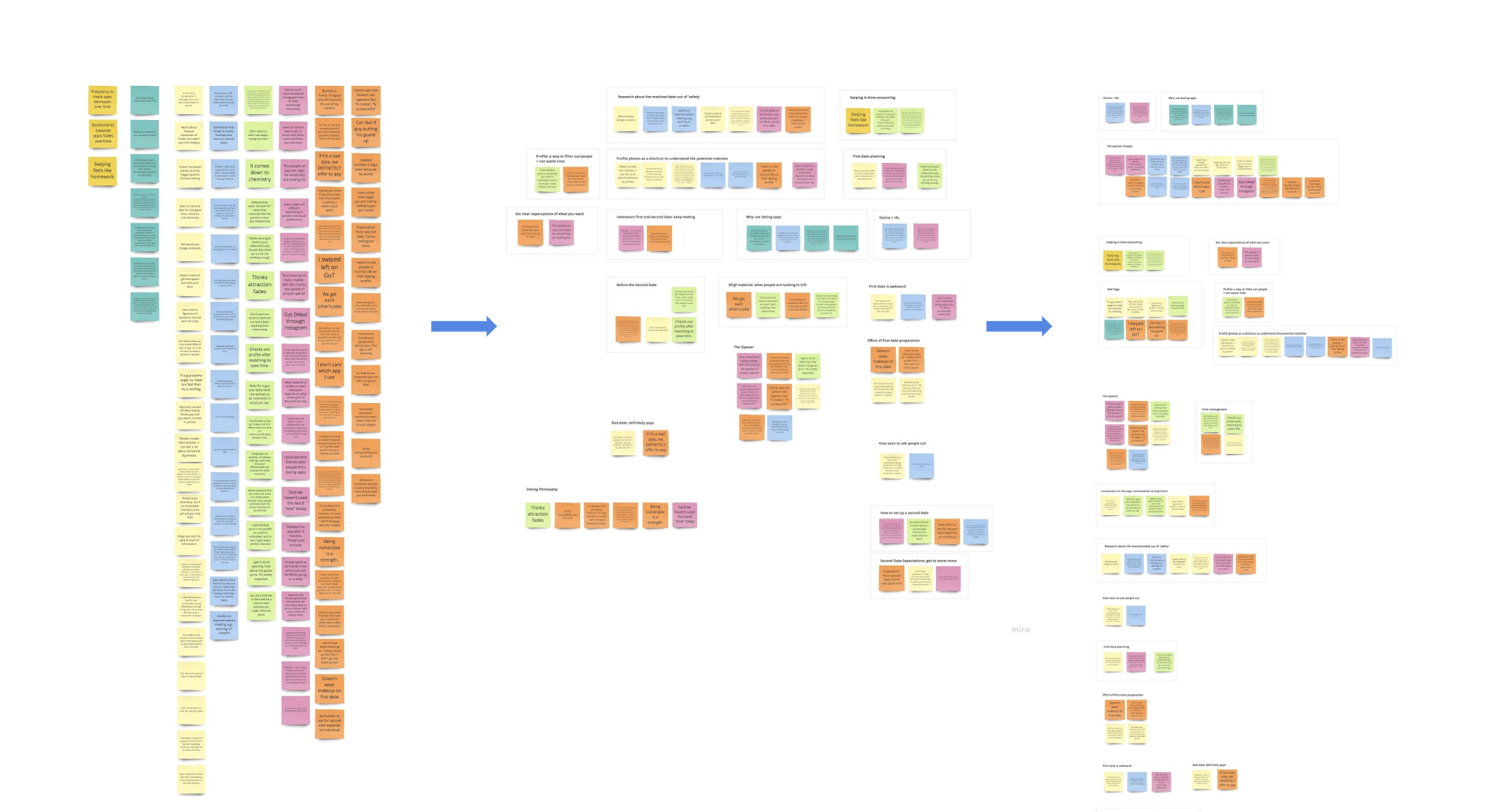
We used immersion and in-vivo coding to identify thematic relationships across diary entries and interview transcripts. The resulting journey moved from swiping, to matching, to chatting, to first date, to more chatting, and then to a second date.

Findings
Getting to a first date
People use quick heuristics to filter matches.
Participants described scanning profiles for red flags, personality cues, and details that reminded them of past experiences.
Conversation flow matters.
Contextual messages and back-and-forth rhythm helped people decide whether a match felt worth meeting.
Someone eventually has to move the interaction offline.
Participants needed enough trust and conversational signal before asking, or being asked, to meet in person.
Safety and authenticity shaped timing.
Concerns about being catfished or feeling unsafe influenced how quickly people wanted to meet.
Getting to a second date
Chemistry carried the decision.
Participants looked for comfort, shared humor, and conversational ease when deciding whether they wanted another date.
Hints worked better than formal asks.
People often tested second-date interest by referencing a shared activity or future event during the first date.
Bad dates produced clear exit signals.
Participants described paying quickly, avoiding ambiguity, or withholding follow-up when they knew a second date would not happen.
Limitations
The project ran in under eight weeks, which shaped the sample size, method choices, and analysis depth. A longer diary window could have captured more variation in how dating-app conversations evolve.
Recruitment also came through our social networks in Seattle and LA, so the findings should be read as directional qualitative insight rather than a generalized model of dating-app behavior.